
Politics
FRENCH MFA JEN NOEL BARROT NAVIGATES GLOBAL CHAOS AMID ELECTION YEAR FEARS
AMID 2027 PRESIDENTIAL ELECTIONS FEARS
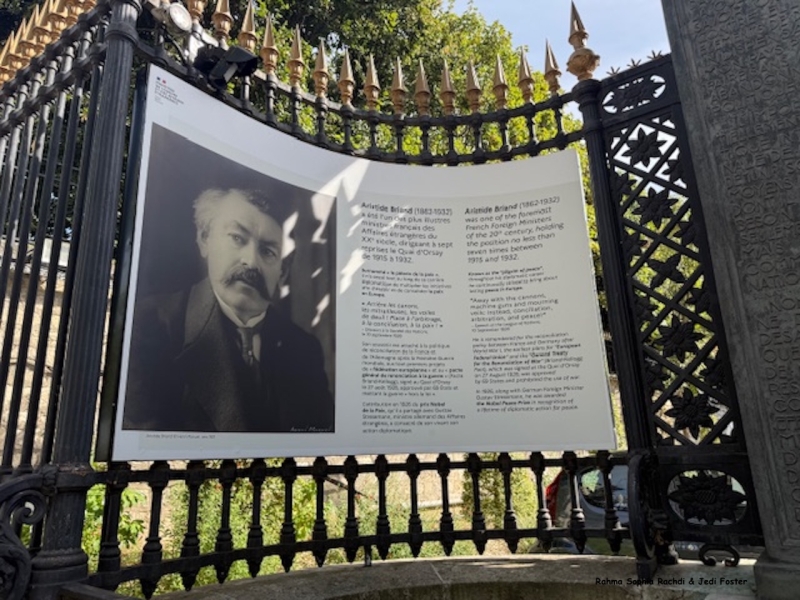
Aristide Briand Former Iconic French MFA
(Source: Rahma Sophia rachdi Jedi Foster)
(Source: Rahma Sophia rachdi Jedi Foster)
I was in the room as Jean-Noel Barrot, France’s Minister for Europe and Foreign Affairs, took the podium. His message was clear: The world is burning, and France must act not just abroad, but at home. His three-pillar strategy reinforcing European sovereignty, asserting France’s leadership at the UN, and reconnecting with the French public reads like a survival manual for a nation caught between global crises and domestic upheaval.
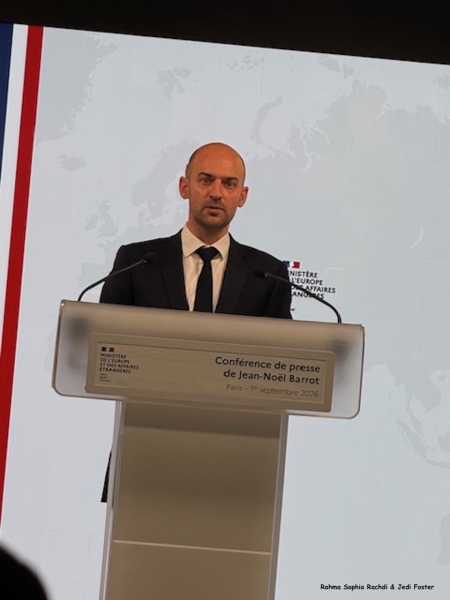
Jean Noel Barrot French MFA/ Press Conf
Source: Rahma Sophia Rachdi, Jedi Foster
Source: Rahma Sophia Rachdi, Jedi Foster
FRENCH MFA BARROT NAVIGATES GLOBAL CHAOS WITH A THREE-PRONGED STRATEGY "Resistant, diplomat, she was the first Frenchwoman to become consul-general then ambassador. Her name, Marcelle Campana remember it. She was a pioneer of diplomacy who paved the way for generations of women after her," declared Jean-Noel Barrot as he opened his annual rentrée press conference at the Quai d’Orsay this week. His words carried more weight than usual. France is hurtling toward presidential elections in 2027, a campaign that has already begun this summer with a crowded field of candidates vying for the supreme office. The Ceuta crisis exploded in late July, with tens of thousands of migrants streaming from Morocco into Spain, straining European borders. And lurking behind it all: Russia’s shadow, with cyberattacks and digital propaganda campaigns threatening to disrupt France’s democratic process.
THE CONTEXT: A WORLD IN FLAMES, A DIPLOMACY UNDER FIRE
The backdrop to Foreign Affairs Minister J.N Barrot’s address was one of unprecedented strain:
• Journalists as targets: Rarely in history have reporters paid such a heavy price for their mission. From Algeria to the Gaza Strip, the profession is under siege, with Christophe Gleizes (detained in Algeria) and Gael Mocaer/Sebastian Perez Pezzani (held in Togo) emblematic of this crisis.
• Geopolitical fractures: The war in Ukraine rages on, with Russia’s strategic failures offset by its relentless hybrid warfare, cyberattacks, disinformation, and sabotage targeting European democracies.
• Economic strangulation: France’s debt servicing costs have surged to 4.2%, crowding out funds for diplomacy, aid, and crisis response. The EU’s trade deficit with China now exceeds €1 billion daily, while climate disasters (e.g., the 2026 Gironde wildfires) drain resources.
"Our strength abroad depends directly on our strength at home," Foreign Affairs Minister Barrot warned, framing the budget debate as "a test of our collective ability to govern."
The backdrop to Foreign Affairs Minister J.N Barrot’s address was one of unprecedented strain:
• Journalists as targets: Rarely in history have reporters paid such a heavy price for their mission. From Algeria to the Gaza Strip, the profession is under siege, with Christophe Gleizes (detained in Algeria) and Gael Mocaer/Sebastian Perez Pezzani (held in Togo) emblematic of this crisis.
• Geopolitical fractures: The war in Ukraine rages on, with Russia’s strategic failures offset by its relentless hybrid warfare, cyberattacks, disinformation, and sabotage targeting European democracies.
• Economic strangulation: France’s debt servicing costs have surged to 4.2%, crowding out funds for diplomacy, aid, and crisis response. The EU’s trade deficit with China now exceeds €1 billion daily, while climate disasters (e.g., the 2026 Gironde wildfires) drain resources.
"Our strength abroad depends directly on our strength at home," Foreign Affairs Minister Barrot warned, framing the budget debate as "a test of our collective ability to govern."
French Foreign Affairs Minister J.N Barrot didn’t mince his words. "Journalists have paid a heavy price in the exercise of their mission. In some regions of the world, on some platforms, you are simply targets," he warned, his voice grave. "Faced with all these upheavals, it would be easy to surrender to fatalism, to defeatism, to throw in the towel and give up. I refuse to do so. France cannot afford to do so," he insisted. "Europe must choose whether it wants to be a diplomatic and military power, whether it wants to strengthen its sovereignty and develop its industry," he declared, outlining the continent’s existential crossroads.
France, he reminded the room, has never been content to watch history pass by. "Everything in its being and soul pushes it to act, never to resign itself, to stand up and say no just as Marcelle Campana and her companions did to lift the country from its knees," Foreign Affairs Minister Jean Noel Barrot concluded. "Today, it is up to us to take up that torch."
France, he reminded the room, has never been content to watch history pass by. "Everything in its being and soul pushes it to act, never to resign itself, to stand up and say no just as Marcelle Campana and her companions did to lift the country from its knees," Foreign Affairs Minister Jean Noel Barrot concluded. "Today, it is up to us to take up that torch."
A WORLD ON THE BRINK: BARROT’S DIAGNOSIS
The Foreign Affairs Minister Barrot didn’t mince words. The global order is fracturing, he said, with democracy under assault, journalists targeted, and authoritarian regimes exploiting every crack. The numbers tell the story: 42% voter turnout in France’s recent municipal elections, 4.2% debt servicing costs choking public coffers, and 500 billion euros in lost revenue for Russia due to sanctions. "We are at a crossroads," Barrot declared. "Will Europe be a museum or a power?"
I scribbled notes as colleagues pressed him on Russia’s hybrid attacks, cyberwarfare, disinformation, sabotage. Jean Noel Barrot’s response was blunt: "We see you. You will not succeed. And there will be consequences." The recent expulsion of Xenia Fedorova, a Russian operative trained in subversion, underscored his point.
The Foreign Affairs Minister Barrot didn’t mince words. The global order is fracturing, he said, with democracy under assault, journalists targeted, and authoritarian regimes exploiting every crack. The numbers tell the story: 42% voter turnout in France’s recent municipal elections, 4.2% debt servicing costs choking public coffers, and 500 billion euros in lost revenue for Russia due to sanctions. "We are at a crossroads," Barrot declared. "Will Europe be a museum or a power?"
I scribbled notes as colleagues pressed him on Russia’s hybrid attacks, cyberwarfare, disinformation, sabotage. Jean Noel Barrot’s response was blunt: "We see you. You will not succeed. And there will be consequences." The recent expulsion of Xenia Fedorova, a Russian operative trained in subversion, underscored his point.
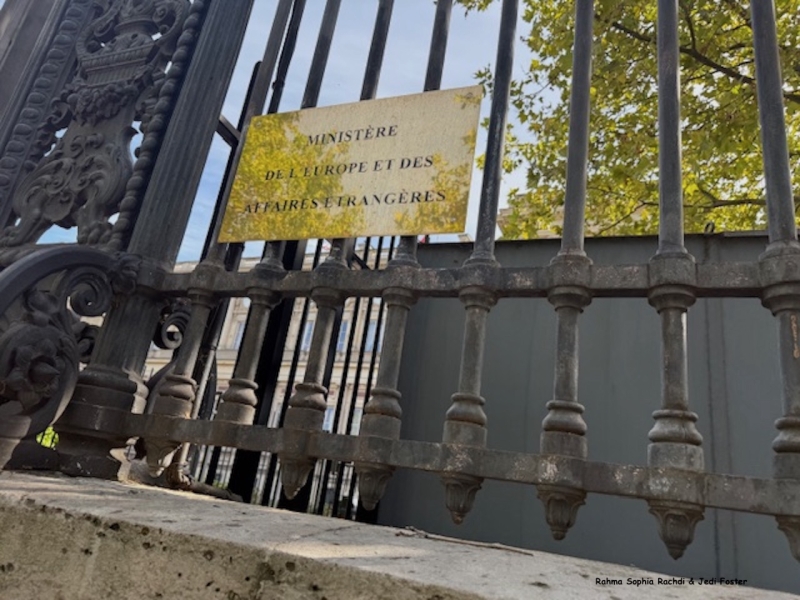
French Ministry for Foreign Affairs
Source: Rahma Sophia Rachdi, Jedi Foster
Source: Rahma Sophia Rachdi, Jedi Foster
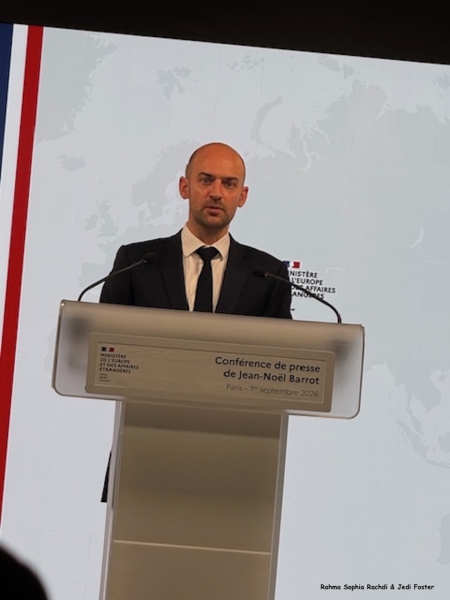
Jean Noel Barrot French MFA/ Press Conf
Source: Rahma Sophia Rachdi, Jedi Foster
Source: Rahma Sophia Rachdi, Jedi Foster
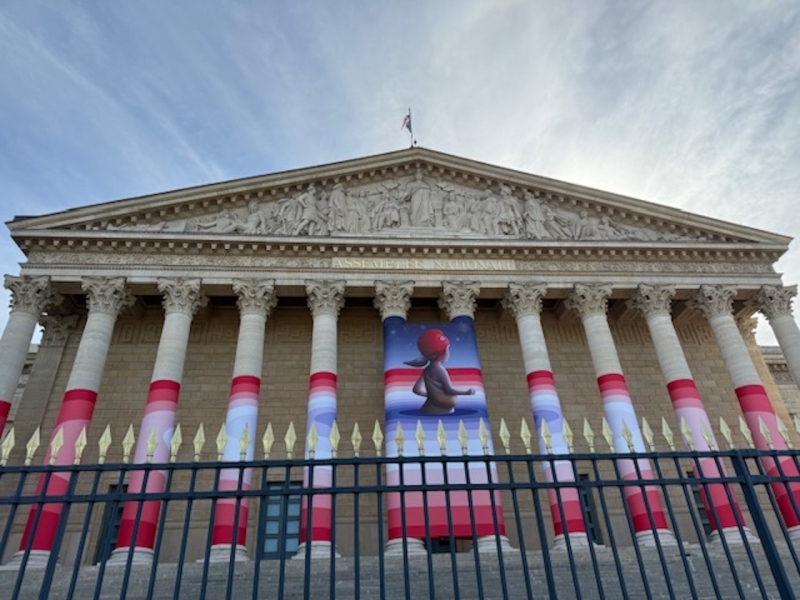
French National Assembly Facade
Source: Rahma Sophia Rachdi, Jedi Foster
Source: Rahma Sophia Rachdi, Jedi Foster
PUBLIC DIPLOMACY: FRANCE’S COUNTEROFFENSIVE
French Foreign Affairs Minister, Barrot’s third priority is reconnecting with the French public, and the Fabrique de la Diplomatie event this week is his answer to foreign interference. 145 young leaders from conflict zones, Ukraine, Lebanon, Sudan, will present a peace resolution at UNESCO. "Democracy is under attack," Barrot warned. "We must shed our naivety."
I caught up with one delegate, a Ukrainian student who fled Mariupol. "This is our chance to be heard," she told me. "Not as victims, but as architects of peace."
French Foreign Affairs Minister, Barrot’s third priority is reconnecting with the French public, and the Fabrique de la Diplomatie event this week is his answer to foreign interference. 145 young leaders from conflict zones, Ukraine, Lebanon, Sudan, will present a peace resolution at UNESCO. "Democracy is under attack," Barrot warned. "We must shed our naivety."
I caught up with one delegate, a Ukrainian student who fled Mariupol. "This is our chance to be heard," she told me. "Not as victims, but as architects of peace."
THE BUDGET BATTLE: A TEST OF FRANCE’S GLOBAL ROLE
Minister Jean Noel Barrot saved his sharpest warning for last: France’s budget paralysis could cripple its diplomacy. With debt servicing costs at 4.2%, funds for aid, defense, and crisis response are drying up. "A country that cannot fund its own budget cannot fund its global role," he said.
The 2026 EU budget negotiations are deadlocked. Barrot’s warning was clear: "If we fail to agree, the consequences will be severe no aid for Ukraine, no support for Lebanon, no leverage in New York."
Minister Jean Noel Barrot saved his sharpest warning for last: France’s budget paralysis could cripple its diplomacy. With debt servicing costs at 4.2%, funds for aid, defense, and crisis response are drying up. "A country that cannot fund its own budget cannot fund its global role," he said.
The 2026 EU budget negotiations are deadlocked. Barrot’s warning was clear: "If we fail to agree, the consequences will be severe no aid for Ukraine, no support for Lebanon, no leverage in New York."
WHAT’S NEXT: BARROT HEADS TO NEW YORK
Foreign Affairs Minister Barrot’s diplomatic marathon isn’t over. On September 22, he’ll join world leaders at the UN General Assembly in New York. He urged journalists to mark September 12, the anniversary of the UN’s landmark declaration on Gaza as a day to reflect on the cost of inaction. "France will not be absent from the table when history is written," he declared.
As he prepares for his final diplomatic sprint before the April 2027 presidential elections, a vote that will mark a new chapter for France, Jean Noeel Barrot knows his legacy will be shaped by how well he steers the nation through these storms. "The torch is passed," he said. "Now it’s our turn to carry it forward."
Foreign Affairs Minister Barrot’s diplomatic marathon isn’t over. On September 22, he’ll join world leaders at the UN General Assembly in New York. He urged journalists to mark September 12, the anniversary of the UN’s landmark declaration on Gaza as a day to reflect on the cost of inaction. "France will not be absent from the table when history is written," he declared.
As he prepares for his final diplomatic sprint before the April 2027 presidential elections, a vote that will mark a new chapter for France, Jean Noeel Barrot knows his legacy will be shaped by how well he steers the nation through these storms. "The torch is passed," he said. "Now it’s our turn to carry it forward."
Liability for this article lies with the author, who also holds the copyright. Editorial content from USPA may be quoted on other websites as long as the quote comprises no more than 5% of the entire text, is marked as such and the source is named (via hyperlink).